

ENT Fellowship in Pune
6 जुलाई 2026
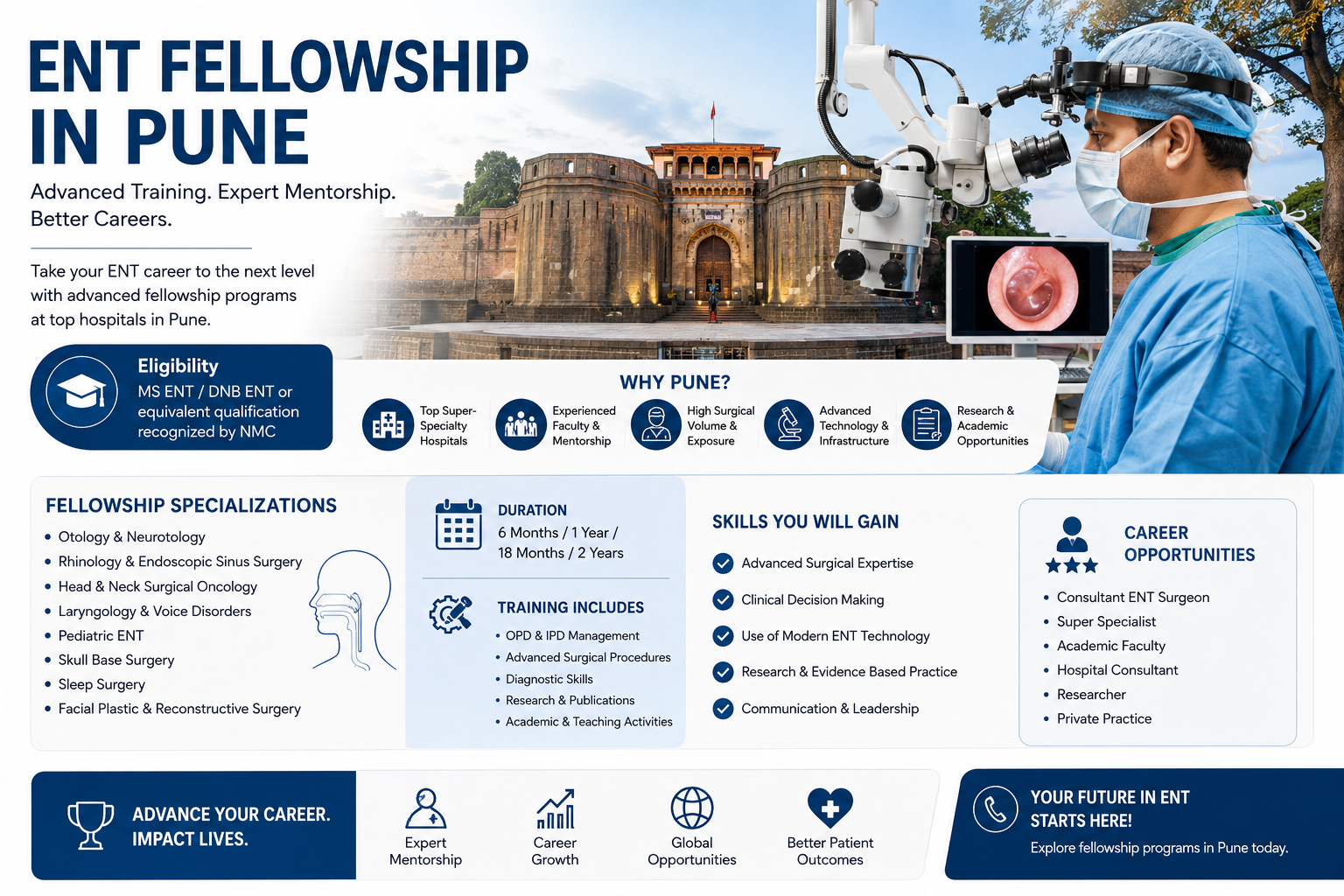
Pune has become one of India’s leading destinations for medical education, advanced surgical training, and super-specialty fellowships. Among various medical specialties, ENT (Ear, Nose & Throat) fellowship programs are increasingly popular because they provide structured, hands-on training beyond postgraduate education.
An ENT fellowship in Pune is designed for doctors who have completed MS ENT or DNB ENT and wish to gain specialized expertise in a particular area such as otology, rhinology, head and neck surgery, skull base surgery, cochlear implantation, laryngology, sleep surgery, pediatric ENT, or facial plastic surgery.
Unlike residency programs, fellowships focus on developing advanced surgical skills, independent decision-making, research experience, and exposure to complex clinical cases. Pune’s well-established healthcare infrastructure, experienced faculty, modern hospitals, and diverse patient population make it an ideal city for ENT fellowship training.
This comprehensive guide covers everything you need to know about pursuing an ENT fellowship in Pune.
Why Choose Pune for an ENT Fellowship?
Pune has evolved into one of India’s fastest-growing healthcare and educational hubs. It combines academic excellence with advanced healthcare facilities, making it an attractive destination for aspiring ENT specialists.
Some of the biggest advantages include:
- High patient volume
- Exposure to rare and complicated ENT diseases
- Advanced surgical technology
- Well-equipped operation theatres
- Experienced mentors
- Research opportunities
- Affordable living compared to Mumbai
- Pleasant climate
- Excellent work-life balance
Many hospitals in Pune regularly perform advanced ENT procedures including:
- Cochlear Implant Surgery
- Endoscopic Sinus Surgery
- Skull Base Surgery
- Thyroid Surgery
- Parotid Surgery
- Head and Neck Cancer Surgery
- Airway Reconstruction
- Laser Microlaryngeal Surgery
- Pediatric ENT Procedures
What is an ENT Fellowship?
An ENT fellowship is an advanced subspecialty training program undertaken after completing postgraduate education in otorhinolaryngology.
Its primary objective is to transform a qualified ENT surgeon into a subspecialist capable of independently managing complex cases.
Unlike residency, fellowship training emphasizes:
- Advanced surgeries
- Clinical judgment
- Research
- Teaching
- Case discussions
- Journal clubs
- Evidence-based practice
Eligibility Criteria
Most fellowship programs in Pune require candidates to have:
- MS ENT
- DNB ENT
- Equivalent recognized postgraduate qualification
Additional requirements may include:
- Valid medical registration
- Updated curriculum vitae
- Letters of recommendation
- Personal statement
- Academic publications (preferred)
- Surgical logbook
- Interview performance
Some institutions may also conduct written examinations.
Types of ENT Fellowships Available in Pune
Different institutions offer fellowships in various subspecialties.
1. Otology Fellowship
Focuses on diseases of the ear.
Training includes:
- Tympanoplasty
- Mastoidectomy
- Ossiculoplasty
- Stapedotomy
- Cochlear Implant Surgery
- Bone Anchored Hearing Devices
- Chronic Ear Disease
- Vertigo Clinics
2. Rhinology Fellowship
Specializes in diseases of the nose and paranasal sinuses.
Procedures include:
- Functional Endoscopic Sinus Surgery (FESS)
- Septoplasty
- Turbinoplasty
- Endoscopic Skull Base Surgery
- CSF Leak Repair
- Nasal Tumor Surgery
- Balloon Sinuplasty
- Allergy Clinics
3. Head and Neck Surgery Fellowship
One of the most demanding fellowships.
Includes management of:
- Oral cancers
- Laryngeal cancer
- Thyroid tumors
- Salivary gland diseases
- Neck dissections
- Reconstructive surgery
4. Laryngology Fellowship
Focuses on disorders of the voice and airway.
Training includes:
- Microlaryngeal Surgery
- Vocal Cord Lesions
- Airway Disorders
- Laser Surgery
- Voice Disorders
- Office Laryngology
5. Pediatric ENT Fellowship
Specializes in ENT disorders affecting children.
Exposure includes:
- Pediatric airway
- Congenital neck masses
- Tonsil and adenoid surgery
- Ear infections
- Hearing loss
- Cochlear implantation
- Airway reconstruction
6. Skull Base Fellowship
One of the most advanced ENT fellowships.
Includes:
- Pituitary surgery
- Skull base tumors
- CSF leak repair
- Endoscopic neurosurgical collaboration
- Complex anatomy
- Image-guided surgery
7. Sleep Surgery Fellowship
Covers:
- Snoring
- Obstructive Sleep Apnea
- Drug-Induced Sleep Endoscopy (DISE)
- Airway Surgery
- CPAP alternatives
8. Facial Plastic Surgery Fellowship
Focuses on:
- Rhinoplasty
- Facial Trauma
- Scar Revision
- Cosmetic Procedures
- Facial Reconstruction
Duration of Fellowship
The duration varies depending on the institution.
Common durations include:
- 6 months
- 1 year
- 18 months
- 2 years
One-year fellowships remain the most common.
Clinical Training
Clinical exposure forms the backbone of fellowship training.
Fellows participate in:
- Outpatient clinics
- Inpatient rounds
- Emergency duties
- Operation theatre
- ICU management
- Multidisciplinary meetings
- Tumor boards
Daily patient interaction helps improve diagnostic accuracy and surgical planning.
Surgical Exposure
Hands-on experience is one of the biggest reasons doctors pursue fellowships.
Depending on the specialization, fellows assist and perform surgeries such as:
Ear Surgery
- Tympanoplasty
- Mastoidectomy
- Cochlear Implant
Nose Surgery
- Septoplasty
- FESS
- Skull Base Surgery
Throat Surgery
- Microlaryngeal Surgery
- Airway Reconstruction
Head & Neck
- Thyroidectomy
- Neck Dissection
- Parotidectomy
- Cancer Surgery
Diagnostic Training
Modern ENT practice relies heavily on advanced diagnostic tools.
Fellows learn:
- Nasal Endoscopy
- Flexible Laryngoscopy
- Stroboscopy
- Vestibular Testing
- Audiology
- BERA
- OAE
- CT Interpretation
- MRI Interpretation
Research Opportunities
Many Pune hospitals encourage research activities.
Research training includes:
- Clinical trials
- Publications
- Journal clubs
- Case reports
- Thesis guidance
- National presentations
- International conferences
Having research publications significantly strengthens future career prospects.
Teaching Responsibilities
Many fellows participate in teaching:
- Undergraduate students
- Junior residents
- Nursing staff
- Audiologists
- Speech therapists
Teaching improves communication and academic skills.
Technology Used During Fellowship
Modern ENT departments utilize advanced technology including:
- Operating Microscopes
- Endoscopes
- Navigation Systems
- Coblation
- Laser Surgery
- High-Speed Drills
- Cochlear Implant Programming
- Video Documentation Systems
- Surgical Navigation
Exposure to advanced technology enhances confidence and surgical precision.
Skills Developed During Fellowship
An ENT fellowship develops both clinical and professional skills.
These include:
Clinical Skills
- Diagnosis
- Treatment planning
- Surgical techniques
- Emergency management
Professional Skills
- Communication
- Leadership
- Teamwork
- Ethics
- Documentation
- Research methodology
Typical Weekly Schedule
Although schedules vary, a fellow’s week may include:
Monday
- OPD
- Minor procedures
Tuesday
- Major OT
Wednesday
- Academic sessions
- Journal club
Thursday
- Surgery
Friday
- Research
- Case discussions
Saturday
- Specialty clinics
- Workshops
Stipend
Some fellowship programs offer stipends, while others are self-funded.
The stipend depends on:
- Institution
- Government vs private hospital
- Fellowship type
- Experience
Applicants should clarify financial details before joining.
Fees
Program fees vary widely.
Factors influencing cost include:
- Institution reputation
- Fellowship duration
- Infrastructure
- Surgical exposure
- Accommodation
- Research facilities
Some fellowships charge tuition fees, while others provide paid training.
Career Opportunities After Fellowship
Completing a fellowship significantly enhances career prospects.
Graduates may work as:
- Consultant ENT Surgeon
- Super-specialist
- Academic Faculty
- Hospital Consultant
- Cochlear Implant Surgeon
- Skull Base Surgeon
- Head & Neck Oncosurgeon
- Researcher
Many also establish successful private practices.
Academic Growth
Fellowship training improves:
- Presentation skills
- Scientific writing
- Research methodology
- Surgical confidence
- International collaboration
These qualities are valuable for careers in teaching hospitals.
International Opportunities
Doctors with advanced fellowship training are often better positioned for:
- International observerships
- Overseas fellowships
- Global conferences
- Collaborative research
- Medical missions
Subspecialty expertise is increasingly valued worldwide.
Advantages of an ENT Fellowship
Key benefits include:
- Advanced surgical training
- Better confidence
- Higher employability
- Improved patient outcomes
- Networking opportunities
- Research experience
- Academic recognition
- Professional growth
Challenges During Fellowship
While rewarding, fellowship training can be demanding.
Common challenges include:
- Long working hours
- Intensive surgical schedules
- Academic commitments
- Research deadlines
- Emergency responsibilities
- Maintaining work-life balance
However, these experiences prepare fellows for independent consultant practice.
Tips for Choosing the Right Fellowship
Before selecting a fellowship, consider:
- Faculty expertise
- Surgical volume
- Hands-on opportunities
- Hospital infrastructure
- Research support
- Case diversity
- Alumni feedback
- Accreditation
- Career goals
Visiting the institution and speaking with current fellows can provide valuable insights.
Documents Required for Application
Applicants are generally asked to submit:
- MBBS Degree
- MS ENT/DNB ENT Certificate
- Medical Registration
- Curriculum Vitae
- Passport-size Photographs
- Identity Proof
- Recommendation Letters
- Personal Statement
- Internship Completion Certificate
- Experience Certificates (if applicable)
Interview Preparation
Candidates should prepare for questions on:
- Basic ENT concepts
- Surgical anatomy
- Clinical decision-making
- Emergency management
- Research interests
- Career goals
- Previous surgical experience
Confidence, professionalism, and enthusiasm for learning are often valued as much as technical knowledge.
Future of ENT Fellowships in India
The field of otorhinolaryngology continues to evolve with innovations in minimally invasive surgery, robotic techniques, artificial intelligence, image-guided navigation, hearing restoration technologies, and precision oncology. As patient expectations rise and healthcare systems become more specialized, fellowship-trained ENT surgeons are increasingly sought after in tertiary care centers, teaching institutions, and private hospitals.
Pune, with its expanding network of multispecialty hospitals and academic institutions, is expected to remain a major center for advanced ENT training. Future fellowship programs are likely to offer greater exposure to robotic surgery, simulation-based learning, telemedicine, interdisciplinary collaboration, and cutting-edge research.
Conclusion
An ENT fellowship in Pune is an excellent opportunity for postgraduate ENT surgeons seeking advanced clinical knowledge, refined surgical skills, and specialized expertise. The city’s combination of experienced mentors, high patient volume, modern medical infrastructure, and academic environment provides an ideal platform for professional growth.
Whether your goal is to become an expert in otology, rhinology, head and neck oncology, pediatric ENT, skull base surgery, or another subspecialty, a well-structured fellowship can significantly enhance your confidence, competence, and career prospects. By carefully evaluating program curriculum, faculty, surgical exposure, research opportunities, and long-term career objectives, aspiring fellows can choose a program that aligns with their professional aspirations and helps them deliver the highest standard of patient care.
लेखक satkriti-admin
टिप्पणी
आपका ईमेल पता प्रकाशित नहीं किया जाएगा। आवश्यक फ़ील्ड * से चिह्नित हैं