

ENT Fellowship in India
8 जुलाई 2026
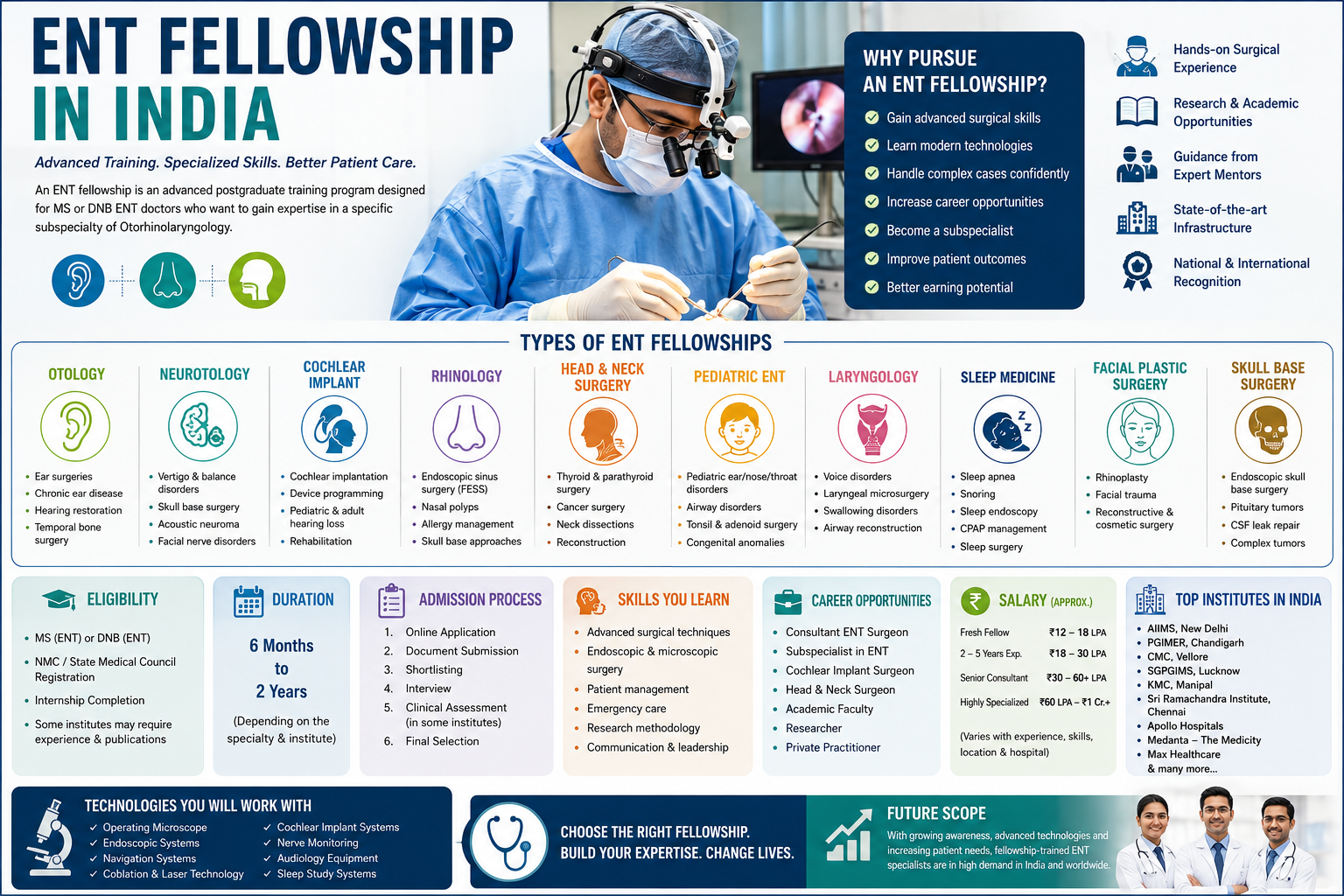
An ENT Fellowship in India is an advanced training program designed for qualified ENT surgeons who wish to develop expertise in a specific subspecialty of Otorhinolaryngology (Ear, Nose, and Throat). After completing an MS (ENT) or DNB (ENT), many doctors pursue fellowships to gain hands-on surgical experience, advanced clinical skills, and specialized knowledge that can significantly enhance their careers.
With rapid advancements in medical technology, minimally invasive surgeries, cochlear implantation, skull base surgery, robotic surgery, and sleep medicine, fellowship programs have become increasingly important for ENT specialists. Hospitals, medical colleges, and private institutions across India now offer various fellowship opportunities focusing on different branches of ENT.
In this comprehensive guide, we will discuss everything you need to know about ENT fellowship programs in India, including eligibility, types of fellowships, duration, admission process, benefits, career opportunities, salary, top institutes, and frequently asked questions.
What is an ENT Fellowship?
An ENT fellowship is a structured postgraduate training program that provides specialized education beyond MS or DNB ENT. Unlike residency, fellowship training focuses on a particular subspecialty and allows doctors to gain extensive exposure to advanced surgical techniques and patient management.
The primary objective of an ENT fellowship is to produce highly skilled specialists capable of managing complex ENT disorders using the latest medical technologies.
During fellowship training, doctors usually work under experienced consultants, participate in surgeries, attend academic sessions, conduct research, publish papers, and learn evidence-based clinical practice.
Why Pursue an ENT Fellowship in India?
India has emerged as one of the leading destinations for advanced medical education due to its:
- Large patient volume
- Diverse clinical cases
- Affordable training
- Highly experienced faculty
- Modern surgical technologies
- Excellent research opportunities
- Exposure to rare ENT disorders
An ENT fellowship helps doctors:
- Develop advanced surgical skills
- Build confidence in handling complex cases
- Learn newer technologies
- Improve patient outcomes
- Increase employability
- Become eligible for consultant-level positions
- Enhance academic careers
Who Can Apply for an ENT Fellowship?
Most institutes require candidates to have:
- MS in ENT
- DNB ENT
- Equivalent postgraduate qualification recognized by the National Medical Commission (NMC)
Some fellowships may also require:
- State Medical Council Registration
- NMC Registration
- Interview
- Surgical logbook
- Recommendation letters
- Research publications (preferred)
Fresh postgraduates and practicing ENT consultants may both apply depending on institute policies.
Types of ENT Fellowships in India
India offers fellowship programs in multiple ENT subspecialties.
1. Otology Fellowship
Otology deals with diseases of the ear and hearing disorders.
Training includes:
- Chronic ear infections
- Tympanoplasty
- Mastoidectomy
- Ossiculoplasty
- Hearing restoration surgery
- Cochlear implantation
- Facial nerve disorders
- Temporal bone surgery
Doctors receive extensive experience in microscopic ear surgeries.
2. Neurotology Fellowship
Neurotology focuses on disorders involving the inner ear, vestibular system, and skull base.
Training covers:
- Vertigo
- Balance disorders
- Vestibular rehabilitation
- Acoustic neuroma
- Skull base surgery
- Facial nerve disorders
- Hearing preservation surgery
3. Cochlear Implant Fellowship
This fellowship specializes in hearing restoration for patients with severe hearing loss.
Training includes:
- Cochlear implant candidacy
- Audiological evaluation
- Surgical implantation
- Device programming
- Speech rehabilitation
- Pediatric hearing loss
- Adult cochlear implants
- Long-term follow-up
4. Rhinology Fellowship
Rhinology deals with disorders of the nose and paranasal sinuses.
Training includes:
- Functional Endoscopic Sinus Surgery (FESS)
- Nasal polyps
- Deviated nasal septum
- Sinus tumors
- Allergy management
- Skull base approaches
- CSF leak repair
- Image-guided surgery
5. Head and Neck Surgery Fellowship
This fellowship focuses on cancers and complex surgeries involving the head and neck.
Training includes:
- Thyroid surgery
- Parathyroid surgery
- Salivary gland surgery
- Oral cancer
- Laryngeal cancer
- Neck dissections
- Reconstructive surgery
- Microvascular reconstruction
6. Pediatric ENT Fellowship
Pediatric ENT focuses on ENT disorders in children.
Training includes:
- Congenital hearing loss
- Airway disorders
- Pediatric sleep apnea
- Tonsil surgery
- Adenoid surgery
- Pediatric ear surgery
- Airway endoscopy
- Tracheostomy care
7. Laryngology Fellowship
Laryngology deals with voice and swallowing disorders.
Training includes:
- Voice disorders
- Vocal cord paralysis
- Laryngeal microsurgery
- Swallowing disorders
- Laser surgery
- Airway reconstruction
- Professional voice management
8. Sleep Medicine Fellowship
Sleep medicine has become one of the fastest-growing ENT subspecialties.
Training includes:
- Sleep apnea
- Snoring
- Drug-induced sleep endoscopy
- CPAP management
- Sleep surgery
- Airway assessment
9. Facial Plastic Surgery Fellowship
This fellowship combines cosmetic and reconstructive ENT surgery.
Training includes:
- Rhinoplasty
- Septorhinoplasty
- Facial trauma
- Scar revision
- Facial reconstruction
- Cosmetic facial procedures
10. Skull Base Surgery Fellowship
One of the most advanced ENT fellowships.
Training involves:
- Endoscopic skull base surgery
- Pituitary tumors
- CSF leak repair
- Complex tumors
- Multidisciplinary surgeries
- Neurosurgical collaboration
Duration of ENT Fellowship
The duration depends on the institution.
Most fellowships last:
- 6 Months
- 1 Year
- 18 Months
- 2 Years
Some advanced programs may extend beyond two years depending on the specialization.
Admission Process
The admission process generally includes:
Step 1
Submit an online application.
Step 2
Upload required documents.
Step 3
Shortlisting.
Step 4
Interview.
Step 5
Clinical assessment (in some institutes).
Step 6
Final selection.
Documents Required
Applicants usually need:
- MBBS degree
- MS/DNB ENT certificate
- Internship completion certificate
- Registration certificate
- Identity proof
- Passport-size photographs
- Updated CV
- Publications (if available)
- Experience certificates
Skills You Learn During Fellowship
An ENT fellowship develops:
- Advanced surgical techniques
- Clinical decision-making
- Microsurgery
- Endoscopic surgery
- Laser surgery
- Patient counselling
- Emergency management
- Team leadership
- Research methodology
- Medical ethics
Surgical Exposure
Depending on the specialty, fellows perform:
- Ear surgeries
- Nose surgeries
- Sinus surgeries
- Cochlear implant surgeries
- Thyroid surgeries
- Neck dissections
- Airway surgeries
- Skull base procedures
- Endoscopic surgeries
- Laser surgeries
Hands-on experience is one of the biggest advantages of fellowship training.
Research Opportunities
Many fellowship programs encourage:
- Clinical research
- Publications
- International presentations
- Journal clubs
- Thesis projects
- Conferences
- Workshops
- Cadaveric dissection courses
Research experience improves academic and career prospects.
Top Institutes Offering ENT Fellowship in India
Several reputed institutions provide advanced ENT fellowship training, including:
- All India Institute of Medical Sciences (AIIMS)
- Postgraduate Institute of Medical Education and Research (PGIMER), Chandigarh
- Christian Medical College (CMC), Vellore
- Sanjay Gandhi Postgraduate Institute of Medical Sciences (SGPGIMS), Lucknow
- Kasturba Medical College (KMC), Manipal
- Sri Ramachandra Institute of Higher Education and Research, Chennai
- Apollo Hospitals
- Medanta – The Medicity
- Max Healthcare
- Narayana Health
- Various university-affiliated hospitals and specialized ENT centers across India.
The availability of fellowship programs, duration, and admission criteria vary by institution.
Technologies Used During Fellowship
Modern ENT fellowships provide training in:
- Operating microscope
- Endoscopic sinus surgery systems
- Navigation systems
- Coblation technology
- Laser surgery
- Cochlear implant systems
- Nerve monitoring
- Audiology equipment
- Video laryngoscopy
- High-speed drills
- Temporal bone laboratory training
- Sleep study equipment
Career Opportunities After ENT Fellowship
After completing fellowship training, doctors can work as:
- Consultant ENT Surgeon
- Super-specialist ENT Consultant
- Cochlear Implant Surgeon
- Head & Neck Surgeon
- Rhinologist
- Otologist
- Neurotologist
- Pediatric ENT Specialist
- Laryngologist
- Facial Plastic Surgeon
- Academic Faculty
- Research Scientist
- Hospital Administrator
- Private Practitioner
Salary After ENT Fellowship in India
Salary depends on:
- Experience
- City
- Hospital
- Specialty
- Surgical expertise
- Reputation
Approximate annual salaries:
| Experience | Salary (Approx.) |
|---|---|
| Fresh Fellow | ₹12–18 LPA |
| 2–5 Years | ₹18–30 LPA |
| Senior Consultant | ₹30–60+ LPA |
| Highly Specialized Consultant | ₹60 LPA to ₹1 Crore+ (depending on practice, institution, and case volume) |
Private practice and highly specialized procedures can substantially increase earnings.
Advantages of ENT Fellowship
Benefits include:
- Higher confidence
- Better surgical exposure
- Improved clinical skills
- Increased earning potential
- Better academic opportunities
- Recognition as a subspecialist
- Opportunities abroad
- Networking with experts
- Enhanced research profile
- Improved patient care
Challenges During Fellowship
While rewarding, fellowship training can be demanding:
- Long working hours
- High surgical workload
- Continuous learning
- Research commitments
- Emergency duties
- Maintaining work-life balance
However, these challenges help build expertise and professional confidence.
Tips for Choosing the Right ENT Fellowship
Before applying, consider:
- Faculty experience
- Surgical case volume
- Hands-on opportunities
- Infrastructure
- Research facilities
- Alumni outcomes
- Accreditation
- Duration
- Stipend
- Future career goals
Visiting the institute or speaking with current fellows can provide valuable insights.
Future of ENT Fellowship in India
The demand for subspecialized ENT surgeons is increasing due to:
- Rising awareness of hearing health
- Increased cochlear implant surgeries
- Growth in minimally invasive procedures
- Better diagnostic technologies
- Expansion of tertiary care hospitals
- Increased burden of head and neck cancers
- Growing focus on sleep disorders and voice care
As healthcare infrastructure expands, fellowship-trained ENT specialists are expected to play a crucial role in delivering advanced patient care.
Frequently Asked Questions (FAQs)
Is an ENT fellowship mandatory after MS or DNB?
No. It is optional but highly beneficial for those seeking subspecialty expertise and advanced surgical training.
Which ENT fellowship has the highest demand?
Cochlear Implant, Head & Neck Surgery, Rhinology, Otology, and Skull Base Surgery are among the most sought-after fellowships.
Can DNB ENT doctors apply for fellowships?
Yes. Most institutions accept both MS (ENT) and DNB (ENT) graduates, provided they meet the eligibility criteria.
How long does an ENT fellowship take?
Most programs range from 6 months to 2 years, depending on the specialty and institution.
Is there a stipend during fellowship?
Many institutions offer a monthly stipend, though the amount varies widely depending on the institute and the fellowship.
Can I start private practice after fellowship?
Yes. Fellowship training can strengthen your expertise and credibility, which may benefit both hospital practice and private practice.
Does fellowship improve career opportunities?
Yes. Fellowship-trained ENT surgeons are often preferred for advanced clinical roles, teaching positions, and specialized surgical services.
Conclusion
An ENT Fellowship in India is an excellent pathway for ENT surgeons who wish to gain advanced clinical expertise, specialized surgical skills, and greater career opportunities. Whether your interest lies in Otology, Rhinology, Cochlear Implant Surgery, Head and Neck Oncology, Pediatric ENT, Laryngology, Sleep Medicine, or Skull Base Surgery, fellowship training offers focused learning under experienced mentors with exposure to complex cases and modern technologies.
Choosing the right fellowship depends on your professional goals, preferred subspecialty, quality of surgical exposure, faculty mentorship, and institutional reputation. With the growing demand for advanced ENT care in India, fellowship-trained specialists are well-positioned to contribute to improved patient outcomes, medical education, and research while building rewarding careers in both public and private healthcare.
लेखक satkriti-admin
टिप्पणी
आपका ईमेल पता प्रकाशित नहीं किया जाएगा। आवश्यक फ़ील्ड * से चिह्नित हैं