
Satkriti Hospital Varanasi: NABH Accredited ENT Centre and What That Accreditation Actually Means for You
October 10, 2026
Most patients choosing a hospital in Varanasi look at three things: the doctor’s reputation, the distance from home, and the bill. Accreditation logos on the wall rarely enter the decision. That is understandable, because nobody explains what they mean.
NABH accreditation is worth understanding, because it is one of the few signals about a hospital that is not self-declared. The hospital does not award it to itself. An external body sends assessors, examines how the hospital actually runs, and either grants accreditation or does not. This article explains what NABH checks, what changes for you inside a NABH accredited hospital, how it connects to Ayushman Bharat and cashless insurance, and what accreditation does not promise. Satkriti Hospital is a NABH accredited ENT centre in Varanasi, and the examples here come from how the standards work in practice at our own facility.
What is NABH accreditation?
NABH stands for the National Accreditation Board for Hospitals and Healthcare Providers. It is a constituent board of the Quality Council of India, which itself was set up by the Government of India, and NABH was formed in 2005. It is the main hospital accreditation system in India.
In simple terms, NABH writes a detailed rulebook for how a safe hospital should run, and then sends trained assessors to check whether a hospital is actually following it. The current hospital accreditation standard is the 6th edition, which came into effect in January 2025.
Accreditation is also not permanent. Hospitals are reassessed on a cycle and have to prove compliance again to keep it. A hospital that slips cannot simply coast on a certificate earned years ago.
What NABH actually examines
The hospital standards cover more than 600 parameters, organised into chapters that follow a patient from the moment they walk in to the moment they go home and come back for follow-up. The areas assessed include:
- Access, assessment and continuity of care
- Care of patients
- Management of medication
- Patient rights and education
- Hospital infection control
- Patient safety and quality improvement
- Responsibilities of management
- Facility management and safety
- Human resource management
- Information management systems
Read that list again from a patient’s point of view. It is not about how expensive the building looks. It is about whether medicines are stored and given correctly, whether instruments are sterilised to a defined protocol, whether staff qualifications are verified, whether your records are complete and retrievable, and whether you were told what your treatment involves before you consented to it.
What this changes for you as a patient
Here is what the standards translate into on the ground. These are the things worth noticing on your next hospital visit, anywhere.
Your identity is confirmed before anything is done to you. Before an injection, a procedure or surgery, staff should verify who you are against your record. This sounds trivial until you consider how many people with similar names pass through a busy hospital in a day.
The surgical site is marked and verified. Before an ear or sinus procedure, the side being operated on is confirmed with you and marked. A formal checklist is run in theatre before anaesthesia and before the incision.
Medicines are tracked, not just handed over. Storage conditions, expiry monitoring, high-risk drug handling and documentation of what was given and when are all defined processes rather than individual habits.
Infection control follows a written protocol. Sterilisation of ENT endoscopes and surgical instruments, hand hygiene, waste segregation and theatre discipline are audited, not left to memory.
You have stated rights, and they must be displayed. The right to know your diagnosis in language you understand, to give informed consent, to know the expected cost, to privacy, to a second opinion, and to complain through a defined channel.
Your records are complete and retrievable. Discharge summaries, operative notes, investigation reports and prescriptions are documented in a standard format. This matters enormously if you later need follow-up elsewhere, or if an insurance or scheme claim is questioned.
Incidents are recorded and reviewed. A NABH hospital is required to track when something goes wrong and show what was changed because of it. Hospitals that do not record problems cannot fix them.
Why accreditation matters particularly in ENT
ENT is a field where quality systems do visible work, for three reasons.
The first is instrumentation. Most ENT diagnosis and surgery runs through endoscopes, microscopes and powered instruments that enter the ear, nose and throat. These are reusable, delicate and difficult to clean. The difference between a hospital with an audited sterilisation protocol and one without is not visible to you at the time, but it determines infection risk.
The second is that ENT surgery is side-specific. Ear surgery, sinus surgery and most nasal procedures are performed on one side. Formal site marking and theatre checklists exist precisely for this category of operation.
The third is that much of ENT is paediatric. Tonsil and adenoid surgery, grommet insertion and hearing assessment are mostly performed on children, where drug dosing is weight-based and the margin for error is narrower. Medication management standards carry more weight here than in most other departments.
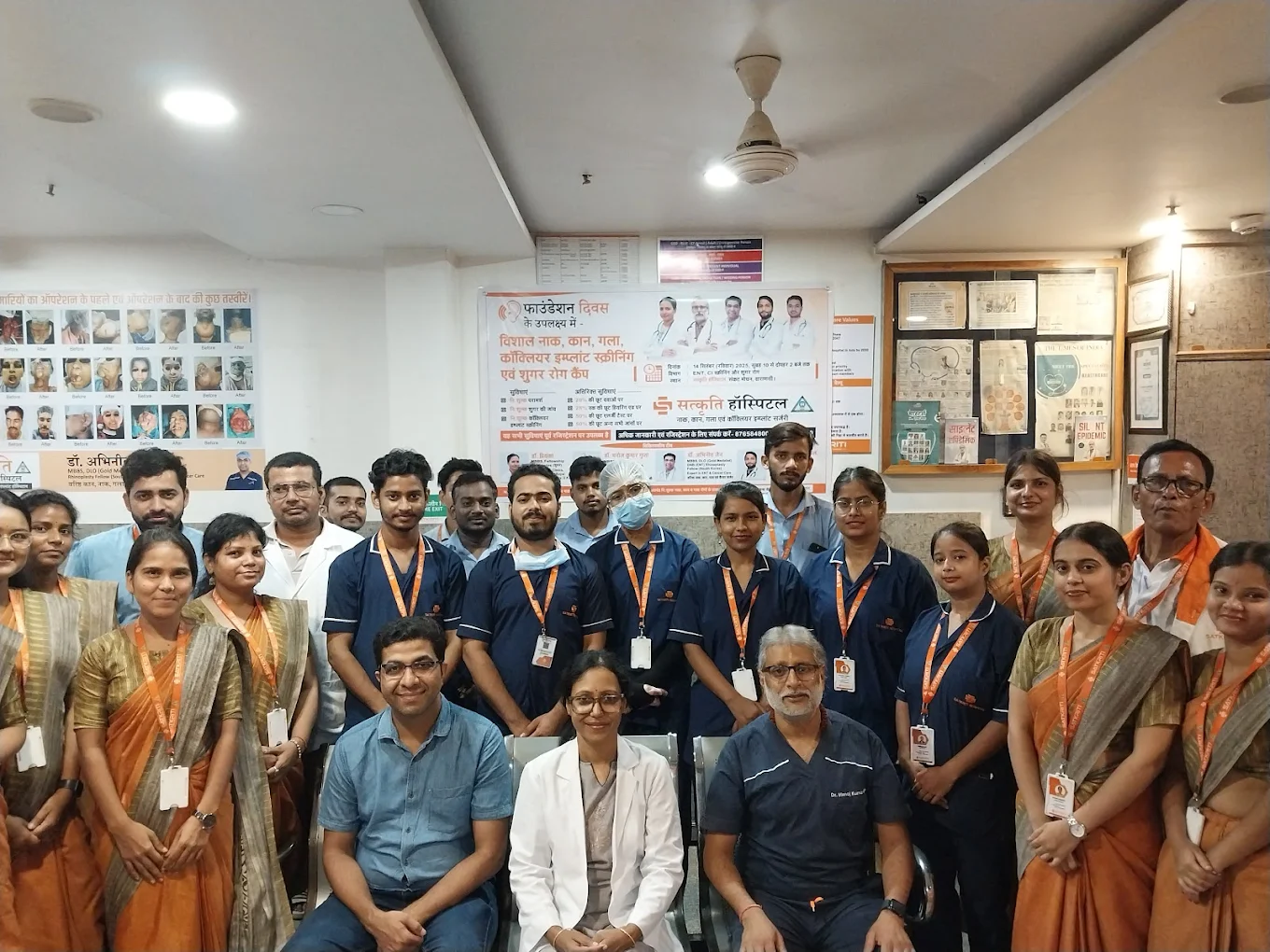
At Satkriti Hospital, this sits alongside a dedicated ENT setup built over more than a decade: a modular operation theatre, four ENT consultants and surgeons, a full audiology suite covering pure tone audiometry, impedance, OAE and BERA, a sleep study lab, and a 24 hour in-house pharmacy. The hospital was founded in 2012 by Dr. Manoj Kumar Gupta, who has worked in ENT for over 25 years, and it was the first centre in the region to introduce coblation surgery and OAE screening.
How NABH connects to Ayushman Bharat and cashless insurance
This is the practical consequence most patients care about, and it is rarely explained.
Government schemes and insurers both need some way to judge whether a hospital meets a minimum standard before they agree to pay it directly. Accreditation is one of the signals used in empanelment decisions and, in several systems, affects the rates a hospital can claim.
For you, the effect is simple. An accredited, empanelled hospital is one where your cover can be used without paying first and claiming later. Satkriti Hospital is empanelled under Ayushman Bharat PM-JAY for ENT treatment, the Pandit Deendayal Upadhyay State Employees Cashless Medical Scheme, the ADIP cochlear implant scheme, and CAPF. On the private insurance side, the hospital works with insurers and TPAs including ICICI Lombard, SBI General, Universal Sompo, Niva Bupa, Aditya Birla Health and Medi Assist.
One clarification that saves wasted trips: at Satkriti Hospital, Ayushman Bharat is used for ENT treatment only, and it covers hospitalisation rather than OPD consultation. Our detailed guidance on eligibility, documents and the pre-authorisation process is on the Ayushman Bharat page of this site.
What NABH accreditation does not promise
An honest article has to include this part.
Accreditation is a statement about systems and processes, not a guarantee of outcome. It does not promise that every surgery will succeed, that every diagnosis will be right, or that you will never wait. It does not rank one accredited hospital above another, and it does not measure a specific surgeon’s skill.
It also does not mean a hospital is expensive, which is a common assumption in Varanasi. Accreditation is about documented safety practice, and an accredited hospital can and does treat patients free of cost under government schemes.
What accreditation genuinely tells you is that an outside body examined how this hospital runs and found the systems in place. Combine that with the surgeon’s specific experience in your condition, and you have a far better basis for a decision than a wall of photographs.
How to check any hospital’s NABH status yourself
Do not rely on a logo on a signboard or a website. Logos are easy to copy and are sometimes left up after accreditation has lapsed.
Go to the official NABH website and use its directory of accredited healthcare organisations. Search by hospital name or by city. The listing will show the accreditation status and the period for which it is valid. If a hospital claims accreditation but does not appear in that directory, ask them directly for the certificate and its validity date. A genuinely accredited hospital will show it without hesitation.
Frequently asked questions
What does NABH accreditation mean in simple words?
It means an independent national body inspected the hospital against a detailed safety and quality rulebook covering over 600 parameters, and confirmed the hospital meets those standards. The hospital cannot award it to itself.
Is a NABH hospital more expensive than a non-accredited one?
Not necessarily. Accreditation relates to safety and documentation standards, not pricing. A NABH accredited hospital can treat patients completely free under Ayushman Bharat and other government schemes.
Is Satkriti Hospital NABH accredited?
Yes. Satkriti Hospital is a NABH accredited ENT and diabetic care facility in Lanka, Varanasi, and is among the small number of accredited hospitals in the city.
Does NABH accreditation help with insurance claims?
It helps in two ways. Accreditation supports empanelment with insurers and government schemes, and the documentation standards it requires mean your discharge summary, operative notes and reports are in the format claim processors expect, which reduces queries and delays.
Does NABH guarantee that my surgery will succeed?
No. It assesses the hospital’s systems, not the outcome of an individual case. Surgical results depend on your specific condition, its stage and the surgeon’s experience with that procedure.
How can I confirm a hospital’s accreditation is still valid?
Search the hospital’s name in the accredited organisation directory on the official NABH website, or ask the hospital for its certificate and check the validity date printed on it.
Can I use Ayushman Bharat at Satkriti Hospital for any treatment?
At Satkriti Hospital, Ayushman Bharat is used for ENT treatment. It applies to hospitalisation, including surgery, in-stay medicines and related investigations, rather than to OPD consultations.
Planning ENT treatment in Varanasi
If you are weighing up where to go for ear, nose or throat treatment, ask any hospital you are considering three questions: is the accreditation current, how many ENT surgeons are on the consultant team, and is the hospital empanelled for the scheme or insurance you hold. The answers tell you more than any brochure.
Satkriti Hospital is at B 32/28, B-19, Sankat Mochan Road, Saket Nagar Colony, Lanka, Varanasi 221005. Call 87658 48001 to check empanelment for your scheme or policy, or to book a consultation.
- Previous: वाराणसी में ENT इलाज के लिए आयुष्मान भारत योजना: कौन पात्र है, आवेदन कैसे करें, और सत्कृति हॉस्पिटल में कौन से इलाज शामिल हैं
- Next: सत्कृति हॉस्पिटल वाराणसी: NABH मान्यता प्राप्त ENT सेंटर और मरीज के लिए इस मान्यता का असली मतलब
- साइनस का दर्द और सर्जरी: Satkriti Hospital में कितना खर्च आता है और इलाज कैसे होता है
- वर्टिगो (चक्कर आना) का कारण, लक्षण और इलाज: सत्कृति हॉस्पिटल, वाराणसी
- Top 10 ENT Specialists in Varanasi 2026: How to Choose the Right ENT Doctor for You
By Satkriti Hospital
Comment
Your email address will not be published. Required fields are marked *